

“When building cloud infrastructure, most teams focus on compute power: CPU, memory, storage. But where your servers are placed relative to one another matters just as much. AWS EC2 Placement Groups let you make that decision deliberately.”
When we think about cloud infrastructure, we usually focus on how powerful our servers are. How much CPU do they have? How much memory? How much storage?
But there is another question that is easy to overlook: where should those servers be placed relative to one another?
AWS provides a feature called EC2 Placement Groups that allows organizations to influence how their EC2 instances are positioned within AWS's underlying infrastructure.
Think of It Like an Office
Imagine a company with several teams working from the same building. Some employees need to communicate constantly, so keeping them close together makes sense. Others may be responsible for critical operations: spreading them across different areas reduces the impact of a problem in one location. And for a large organization, employees may be divided into separate departments or sections.
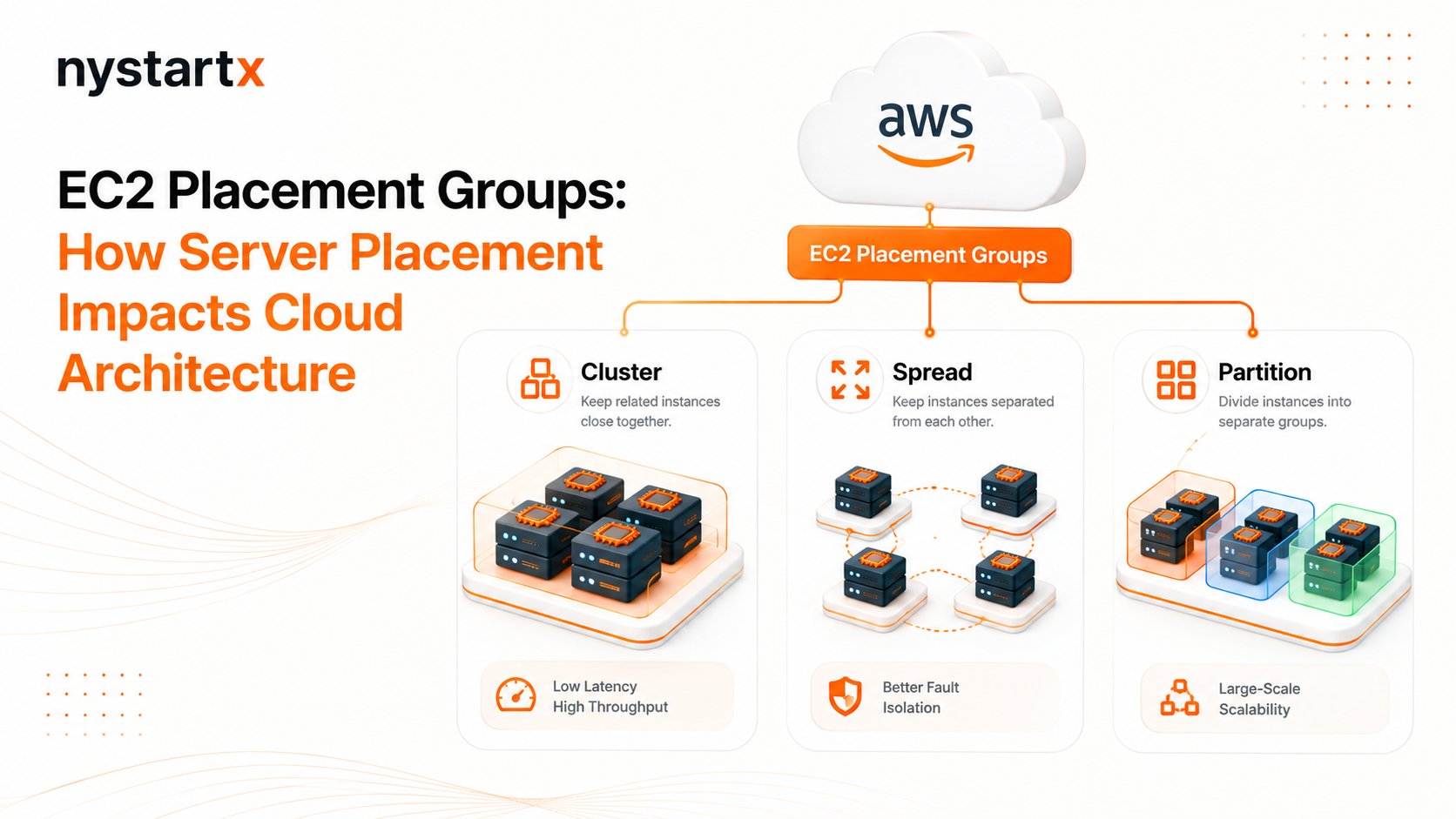
EC2 Placement Groups work with a similar principle. Depending on the workload, you can choose how your EC2 instances should be positioned. AWS provides three placement strategies.
1. Cluster Placement Group
Keep related instances close together. The goal is to achieve low network latency and high network throughput between instances. This is useful when multiple servers need to communicate with each other very frequently.
- High-performance computing
- Large-scale data processing
- Workloads requiring very fast communication between instances
Think of it as putting people who constantly collaborate in the same room. The advantage is speed. The trade-off is that concentrating resources more closely provides less physical separation.
2. Spread Placement Group
Keep instances separated from each other. The goal is to reduce the possibility that a single underlying hardware failure affects multiple instances.
Imagine you have several critical application servers. Instead of putting them together, you want them distributed across separate underlying hardware. That way, an infrastructure problem affecting one server has less chance of affecting the others.
Think of it as keeping important business operations in different buildings. The advantage is greater fault isolation: particularly useful when individual instances are critical and you want to reduce correlated failures.
3. Partition Placement Group
Divide instances into separate groups, or partitions. Each partition is designed to have its own set of underlying hardware, helping isolate failures between partitions.
This is particularly useful for large distributed systems such as:
- Apache Kafka
- Cassandra
- Hadoop
- Large distributed databases
Think of it as dividing a large organization into separate departments, where a problem in one department does not necessarily affect every other department.
So Which One Should You Use?
There is no universally best placement strategy. The right choice depends on what your workload needs.
- Cluster: Performance: keep instances close for fast communication
- Spread: Fault isolation: keep instances apart to reduce correlated failures
- Partition: Large-scale isolation: divide into groups for distributed systems
The important architectural question is: what matters more for this workload: performance, fault isolation, or distributed scalability?
Why Should Businesses Care?
For a technical team, Placement Groups are an infrastructure configuration. For a business, the underlying decision is about trade-offs.
A system that requires extremely fast communication between servers may prioritize performance. A business running critical services may prioritize reducing the impact of infrastructure failures. A large distributed platform may need a balance between scale and failure isolation.
These decisions can ultimately influence application performance, system reliability, fault tolerance, scalability, and overall infrastructure design.
A Small AWS Concept With a Bigger Lesson
EC2 Placement Groups are just one feature within AWS, but they demonstrate an important principle of cloud architecture: infrastructure decisions should be driven by the requirements of the application: not simply by the availability of a technology.
Understanding these fundamentals helps engineering teams build systems that are not only functional, but also reliable, scalable, and designed for the business they support.
At nystartx, we explore these infrastructure and architecture decisions to help businesses make better use of modern cloud technologies.
Related Engineering Blueprints
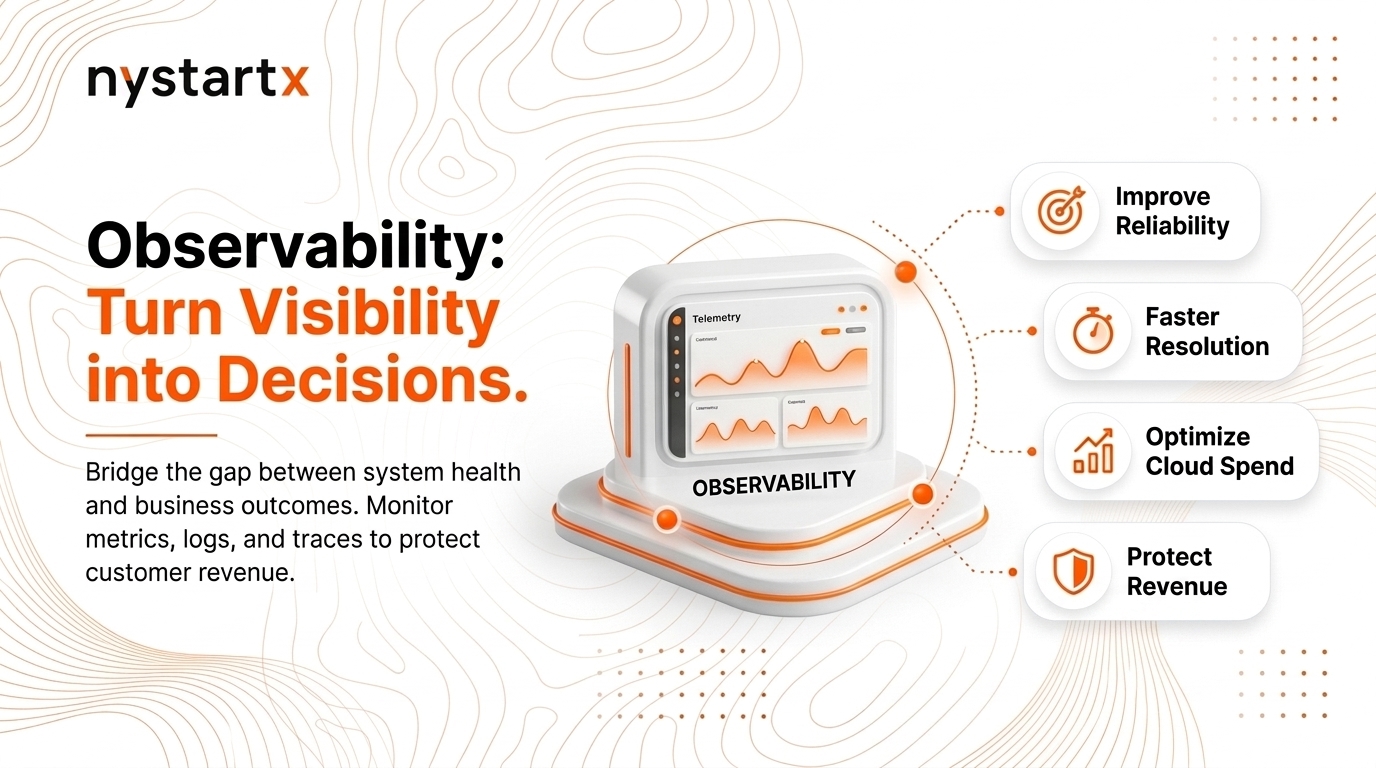
Observability: Turning System Visibility Into Better Business Decisions
Your dashboards are green, but transactions are failing. Discover how enterprise observability transforms telemetry (metrics, logs, and distributed traces) into actionable business outcomes, rapid incident resolution, and cloud cost control.

AWS WAF: What It Costs and When You Actually Need It
AWS WAF is often treated as a standard production checkbox. Explore real-world pricing dimensions, traffic-based cost profiles, and when it is genuinely justified in enterprise architectures.
Schedule a direct technical consultation with our engineering team.
Direct access to experienced technical leads. No sales pressure, just rigorous architectural review of your cloud infrastructure, Salesforce org, or application roadmap.